Showing posts with label o. Show all posts

Word of The Day for Monday, July 4, 2011

onomastics

on•o•mas•tics (on-uh-MAS-tiks)  n

Definition:
1. the study of the origin, history, and use of proper names
2. the system underlying the formation and use of words especially for proper names or of words used in a specialized field


onomastician noun; onomastic adjective


Origin:
1936; from Fr. onomastique, from Gk. onomastikos "of or belonging to naming," from onomastos "named," verbal adj. of onomazein "to name," from onoma "name"

Related:
Related Words: onomatopoeia, anonymous, eponymous, synonym, homonym

Sentence Examples:
• Essentially we can identify two periods in the development of onomastics in the GDR. ... In the first period the basis was established for the mining of knowledge; in this period, the methodological bases of interdisciplinary research in the field of onomastics and the history of settlement were generally firmly established, and a major part of the material basis for analysis was processed. - Le nom propre au carrefour des études humaines et des sciences, Jean-Claude Boulanger

• The first inventory of Greek names is that of W. Pape and G. Besnlser. ...  This work remains a useful catalogue of literary names, but its utility is limited by the fact that it includes on inscriptions listed in CIG and no names attested in papyri. ... Fortunately, many other onomastic reference aids have been published over the past century. - An introduction to Greek epigraphy of the Hellenistic and Roman, Bradley Hudson McLean

• Of the other names, Shellu, Kushshu, Ḥuluḳḳu, and Zinu seem to be Semitic; at any rate they occur frequently, or in cognate forms, well known among the Assyrians and Babylonians. The others are all very unfamiliar. We are as yet so imperfectly acquainted with the onomastics of the nations surrounding the Semites that it is hazardous to attempt to locate these people. Supposing them to be all of one race, they may belong to a colony settled near Sippara, but the whole style of the language is so unlike the Sippara documents that we can hardly suppose that to be the case.  - Babylonian and Assyrian Laws, Contracts and Letters, C. H. W. Johns

Wikipedia:

Onomastics or onomatology is the study of proper names of all kinds and the origins of names. ... Toponymy or toponomastics, the study of place names, is one of the principal branches of onomastics. Anthroponomastics is the study of personal names.

Sources: Merriam-Webster, Dictionary.com, Online Etymology

Word-E: A Word-A-Day

Word of The Day for Friday, May 20, 2011

otiose

o•ti•ose (OH-shee-ohs, OH-tee-) adj

Definition:
1. producing no useful result, futile
2. being at leisure, idle, lazy, indolent
3. lacking use or effect, superfluous


otioseness, otiosity noun; otiosely adverb


Origin:
1794; from L. otiosus "having leisure or ease, not busy" (cf. Fr. oiseux, Sp. ocioso, It. otioso), from otium "leisure," of unknown origin, meaning "at leisure, idle" is recorded from 1850

Related:
Synonyms: listless, slothful, futile, hopeless, ineffective, useless, futile, hollow, idle, inactive, indolent, ineffective, laggard, lazy, slothful, sterile, superfluous, surplus
Related Words: negotiation, from neg- "not" + otium "ease, leisure"

Sentence Examples:
• The hall was constructed in the manner of a Roman atrium, and from the oblong pool of turgid water in the centre a troop of fat and otiose rats fled weakly squealing at my approach. - Prince Zaleski, M.P. Shiel

• The otiose, the facile, surplusage: why are these abhorrent to the true literary artist, except because, in literary as in all other arts, structure is all important, felt or painfully missed, everywhere?--that architectural conception of work, which foresees the end in the beginning, and never loses sight of it, and in every part is conscious of all the rest, till the last sentence does but, with undiminished vigour, unfold and justify the first--a condition of literary art, which, in contradistinction to another quality of the artist himself, to be spoken of later, I shall call the necessity of mind in style. - How to Fail in Literature, Andrew Lang

• It remains only to be said, by way of conclusion to this brief survey, that, for those who are disposed to open their sensibilities to the appeal of this music, its high and haunting beauty must exert an increasing sway over the heart and the imagination. It is making no excessive or invidious claim for it to assert that, after one has truly savored its quality, other music, transcendent though it may demonstrably be, seems a little coarse-fibred, a little otiose, a little—as Jules Laforgue might have said—quotidienne. - Debussy's Pelléas et Mélisande, Lawrence Gilman


Sources: Merriam-Webster, Dictioanry.com, Online Etymology

Word-E: A Word-A-Day

Word of The Day for Thursday, April 14, 2011

obsequy

ob•se•quy (OB-si-kwee)  n
usually plural, obsequies

Definition:
a funeral rite or ceremony
Origin:
late 14c., from L. obsequium "compliance, dutiful service," from obsequi "to accommodate oneself to the will of another," from ob "after" + sequi "follow"

Related:
Synonyms: eulogy, funeral rite, funeral service
Related Words: obsequious

Sentence Examples:
• This visit had probably no other motive than to make sure that this prince was really alive, he having been reputed dead of the plague for over thirty years, and his obsequies having been celebrated in presence of an entire army. - Celebrated Crimes, Alexandre Dumas

• It will be recalled without effort—possibly, indeed, without interest—that the obsequies of the old Senator Boligand were a distinguished success: a fashionable, proper function, ordered by the young widow with exquisite taste, as all the world said, and conducted without reproach, as the undertaker and the clergy very heartily agreed. -The Mother, Norman Duncan

• Now there were no wars at that time so far as was known in Spain, but that old lord's eldest son, regarding those last words of his father as a commandment, determined then and there in that dim, vast chamber to gird his legacy to him and seek for the wars, wherever the wars might be, so soon as the obsequies of the sepulture were ended. -Don Rodriguez, Edward John Moreton Drax Plunkett


Sources: Dictionary.com, Online Etymology

Word-E: A Word-A-Day
Word of The Day for Wednesday, March 16, 2011

obrogate

ob•ro•gate (OB-ruh-geyt)  v

Definition:
to annul indirectly by enacting a new and contrary law, instead of by expressly abrogating or repealing the old one

obrogated past participle; obrogated past tense; obrogating present participle; obrogates 3rd person singular present; obrogation noun

Origin:
from Latin obrogatus, p. p. of obrogare "to obrogate"

Related:
Synonyms: abolish, annul, cancel, dissolve, invalidate, negate, nix, nullify, undo, vacate, vitiate, void

Sentence Examples:
• In the new Code of Canon Law there are many instances of revocation or obrogation of older legislation, as in the matter of censures and matrimonial impediments.  -Moral Theology, John A. McHugh and Charles J. Callan

• If these considerations justify the view that Gracchus contemplated the cognizance of the plebs, the clause of the Twelve Tables which claimed capital causes for the centuries was obrogated so far as this particular jurisdiction was concerned. But the conservative lawyers whom Cicero quotes seem not to have admitted the obrogation, and still appeal to the clause of the Tables as stating a fundamental principle of the constitution.  -The legal procedure of Cicero's time, Abel Hendy Jones Greenidge

• Israel fears the obrogation of its peace treaty with Egypt. That is understandable - but this is a popular uprising and the people are making legitimate demands - and guess what.....Israel is NOT the reason why the people protest.

Sources: Free Dictionary, Dictionary.com

Word-E: A Word-A-Day

Word of The Day for Wednesday, February 23, 2011

oblation

o•bla•tion (o-BLEY-shuhn)  n

Definition:
1. the act of offering something, such as worship or thanks, to a deity
2. a charitable offering or gift
3. the offering of the bread and wine of the Eucharist to God

oblatory, oblational adjectiveb
Origin:
1375–1425; from O.Fr. oblation "offering, sacrifice," from L. oblationem (nom. oblatio) "an offering, presenting, gift," in L.L. "sacrifice," from L. oblatus variant pp. of L. offerre "to offer, to bring before" (latus "carried, borne" used as suppletive pp. of ferre "to bear"), from *tlatos, from PIE base *tel-, *tol- "to bear, carry"

Related:
Synonyms: offering
Related Words: offertory, oblate

Sentence Examples:
• Through the air he flies looking down upon all beings: with the majesty of the heavenly dog, with that oblation would we pay homage to thee. -Cerberus, The Dog of Hades, Maurice Bloomfield

• Often they are very fine; but always they are the work of priests, artists in ritual. And if you look heedfully into it you will also mark that these priests are inclined to think that the act of sacrifice, the offering of, say, certain oblations in a particular manner with particular words accompanying them, is in itself potent, quite apart from the psalms which they sing over it, that it has a magic power of its own over the machinery of nature. -Hindu Gods And Heroes, Lionel D.  Barnett

• Again, their insinuations that in the mass Christ is not offered must be altogether rejected, as condemned of old and excluded by the faithful. For Augustine says this was a very ancient heresy of the Arians, who denied that in the mass an oblation was made for the living and the dead. -The Confutatio Pontificia, Anonymous

Sources: Free Dictionary, Online Etymology

Word-E: A Word-A-Day

Word of The Day for Friday, January 21, 2011

obloquy

ob•lo•quy (OB-luh-kwee)  n

Definition:
1. censure, blame, or abusive language aimed at a person or thing, esp. by numerous persons or by the general public
2. discredit, disgrace, or bad repute resulting from public blame, abuse, or denunciation

obloquies plural; obloquial adjective

Origin:
1425–75; from L.L. obloquium "speaking against, contradiction," from ob "against" + loqui "to speak," from PIE *tolkw-/*tlokw- "to speak"

Related:
Synonyms: thersitical, reproach, calumny, aspersion, revilement, abuse, animadversion, aspersion, censure, criticism, defamation, disgrace, humiliation, ignominy, insult, invective, reproach, slander, vituperation, contumely
Related Words: loquitur, loquacious, soliloquy,interlocutor, magniloquence, grandiloquence, colloquy, locution, somniloquy, ventriloquy, circumlocution

Sentence Examples:
• It was the galling reflection that Calais was lost to the French in a Spanish quarrel that crowned the poor Queen's obloquy. She had lost it through wanton neglect.  -The Reign of Mary Tudor, James Anthony Froude

• I said I supposed he would wish me to act as his second, and he said, "Of course." I said I must be allowed to act under a French name, so that I might be shielded from obloquy in my country, in case of fatal results.  -A Tramp Abroad, Mark Twain

• Marguerite, after the death of the Queen her mother and her brothers, though sole heiress of the House of Valois, was, by the Salic law, excluded from all pretensions to the Crown of France; and though for the greater part of her life shut up in a castle, surrounded by rocks and mountains, she has not escaped the shafts of obloquy. -Memoirs of Marguerite de Valois

The Storyline

The lecture started to well up inside Anna the obloquy she had been holding to for too long. She thought she had made her peace. And these emotions frightened her a little.

Sources: Dictionary.com, Online Etymology

Word-E: A Word-A-Day

Word of The Day for Saturday, January 8, 2011

orotund

or•o•tund (AWR-uh-tuhnd)  adj

Definition:
1. marked by fullness, strength, and clarity of sound : sonorous
2. pompous, bombastic

orotundity noun

Origin:
1799; modification of Latin ore rotundo, literally, with round mouth

Related:
Synonyms: ostentatious, bombastic, clear, pompous, resonant, resounding, rich, sonorous, stentorian
Related Words: rotund

Sentence Examples:
• The orotund quality which is so effective in impassioned utterance, and in the expression of deep, forcible, and sublime emotions, is nothing more than pure tone increased in extent of volume, and in intensity of force. This modification of pure tone is very full, very rounds very smooth, and very highly resonant or ringing. -The American Union Speaker, John D. Philbrick

• There is one criticism that has been constantly brought against Morris, and although he answered this criticism a thousand times during his life, it still springs fresh—put forth by little men who congratulate themselves on having scored a point. They ask in orotund, "How could William Morris expect to benefit society at large, when all of the products he manufactured were so high in price that only the rich could buy them?" -Little Journeys to the Homes of the Great, Elbert Hubbard

• "The dynasty of the house of Thornton must end to-day!" boomed Niles, in his best orotund. Thornton found eyes in the crowd that blinked appreciation. Quizzical wrinkles deepened in his broad face. He plucked a cigar from his waistcoat-pocket and held it down toward Mr. Niles. -The Ramrodders, Holman Day

The Storyline
She reached her desk again and attempted to bury herself in her work. "Anna," she heard and froze for a moment at the recognition of that unmistakable orotund voice.

Sources: Merriam-Webster

Word-E: A Word-A-Day

Word of The Day for Friday, November 26, 2010

oscitant

os•ci•tant (OS-i-tuhnt)  adj

Definition:
1. being inattentive or absentminded; dull, lazy, or negligent
2. yawning; gaping
3. being drowsy or dozy

oscitancy, oscitance noun; oscitantly adverb

Origin:
1615–25; from L. oscitans, prp. of oscitare "to gape, yawn," from os citare "to move the mouth"

Related:
Synonyms:  drowsy, dull, insensible, languorous,  lethargic, nodding, sluggish,  hebetudinous;
(nouns) lentor, statuvolence, pandiculation, segnitude, segnity, somnolence, stupor, torpescence, torpidity, torpor

Related Words: citation (from O.Fr. citation, from L. citationem (nom. citatio) "a command," noun of action from pp. stem of citare "to summon, to put in motion, to call forward")
incite (from M.Fr. enciter (14c.), from L. incitare "to put into rapid motion, urge, encourage, stimulate," from in- "on" + citare "move, excite")
recite (from L. recitare "read aloud, repeat from memory," from re- "back, again"  + citare "to summon")


Sentence Examples:
• If men so uncultivated possessed any vestiges of christianity, being totally unfit for the genuine wisdom and goodness of that divine system, they must have received it with the grossest corruptions which it had acquired from interested imposture, oscitant negligence, or torpid stupidity. -The history of England, David Hume,1810

• The sanguine genius of Commerce differed with Rome, whose course,when unobservant of military armor and martial scenes, became oscitant and drowsy. -Hunt's merchants' magazine and commercial review, 1852

• Let not our minds waver and hover, in reference hereunto, as if this were a doubtful matter, as if possibly, it might he otherwise, as if either he were ignorant or oscitant, and unconcerned about the affairs of his creature, as if any thing might possibly fall out without his advertency. -The posthumous works of John Howe, ed. by J. Hunt, 1832

The Storyline
Finally off the phone and finding a second of quietude, Anna slumped into her chair and let out a wide yawn, staring oscitantly into space before rousing herself and heading off to get dressed for the day.

Why This Word:
Sated by turkey and tryptophan, stuffing and sugar, we can be excused if today we are bit oscitant.

Sources: Websters Online, Online Etymology

Word-E: A Word-A-Day

Word of The Day for Saturday, November 20, 2010

opuscule

op•us•cule (oh-PUHS-kyool)  n

Definition:
1. a small or minor work
2. a literary or musical work of small size

opuscular adjective

Origin:
1650–60;  < F < L opusculum,  equiv. to opus  work + -culum -cule

Related:
Related Words: opus, opera

Sentence Examples:
• In 1822 he published a Plan of the Scientific Works necessary to Reorganise Society. In this opuscule he points out that modern society is passing through a great crisis, due to the conflict of two opposing movements,—the first, a disorganising movement owing to the break-up of old institutions and beliefs; the second, a movement towards a definite social state, in which all means of human prosperity will receive their most complete development and most direct application.

• It has been customary, of late years, for the purveyors of amusing literature—the popular authors of the day—to put forth certain opuscules, denominated 'Christmas Books,' with the ostensible intention of swelling the tide of exhilaration, or other expansive emotions, incident upon the exodus of the old and the inauguration of the new year. -The Christmas Books, William Makepeace Thackeray

• Yet neither he nor any one else on his side has ever effectively shaken the solid argument which Diderot fancifully illustrated in the following passage from his reply to Voltaire's letter of thanks for the opuscule: "This marvellous order and these wondrous adaptations, what am I to think of them? -Diderot, John Morley

The Storyline
And so on it went with a series of oft-reiterated lines and anecdotes that Anna knew well enough to be able to compose an opuscule from them.

Why This Word:
I could write a minor opus on this word. There's a formality in the feel of opuscule that conjures up a short formal treatise. And yet ours is the age of the opuscule, short works for the short-attention-span generation. I'd say more perhaps, but I've already exceeded 140 characters and I've probably lost some peoples' attention.

Sources: Dictionary.com

Word-E: A Word-A-Day

Word of The Day for Friday, November 5, 2010

ossuary

os•su•ar•y (OS-oo-er-ee)  n

Definition:
a place where the bones of the dead are deposited; a charnel house

Related:
Synonyms: casket, coffin, charnel house
Related Words: osseous, ossify

Sentence Examples:
• In the middle, an open ossuary contains skeletons that have been exhumed in order to make room for other corpses. Who has said: "Life is a hostelry, and the grave is our home?" But these corpses do not remain in their graves, for they are only tenants and are ejected at the expiration of the lease. -Over Strand and Field, Gustave Flaubert, 1904

• Here and there amid this enormous game of knucklebones there could be traced the imaginary ruins of medieval cities with forts and dungeons, pepper-box turrets, and machicolated towers. And in truth these Bad Lands are an immense ossuary where lie bleaching in the sun myriads of fragments of pachyderms, chelonians, and even, some would have us believe, fossil men, overwhelmed by unknown cataclysms ages and ages ago. -Robur the Conqueror, Jules Verne, 1886

• While the old hut-man was lamenting and adding another chapter to the horrors of the mountain, hoping for fresh ossuary relics for his charnel glass-case, the Swedish youth and his guides, who had returned from their expedition, set off in search of the hapless Tartarin with ropes, ladders, in short a whole life-saving outfit, alas! unavailing... -Tartarin On The Alps, Alphonse Daudet, 1887

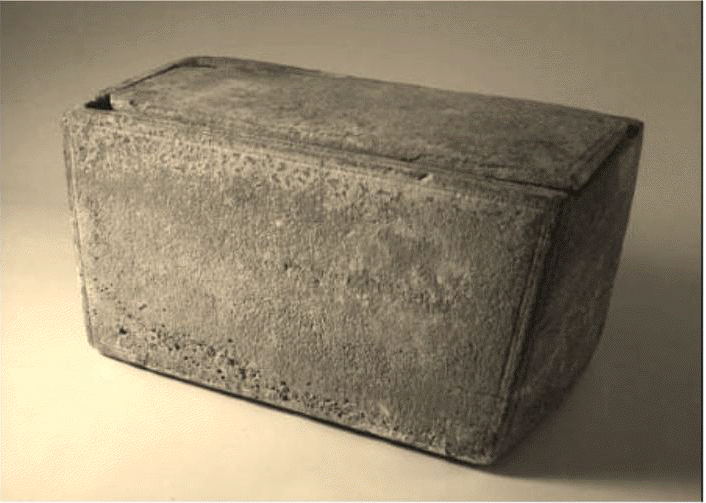
The Ossuary of James

The Sedlec Ossuary in the Czech Republic
The Storyline
"Your brother just got back from Israel. He and his research assistant where there to examine the Ossuary of James," she started without so much as a how-are-you.

Origin:
1658, "an urn for the bones of the dead," from L.L. ossuarium "charnel house," from L. os "bone"

Sources: Webster's 1913 Dictionary, Online Etymology

Why This Word:

To get down to the bone of the matter, as opposed to a casket or coffin, an ossuary is a building, room or receptacle for the storage of bones not bodies - perhaps in mass or perhaps after putting the body out to decay naturally on a stone "table" and then collecting the remaining bones.
They are frequently used where burial space is scarce. A body is first buried in a temporary grave, then after some years the skeletal remains are removed and placed in an ossuary.
The use of an ossuary would just seem bizarre to us today in the West, a relic of more "primitive" times. We prefer a more sanitized approach. We lay out our dead all decked out and made-up to seem alive, in satin-lined and very expensive boxes. Our answer to the shortage of space for individual burials is cremation. But an ossuary in some form or another would make perfect sense over much of the span of human history.

Word-E: A Word-A-Day

Word of The Day for Tuesday, October 19, 2010

obdormition

ob•dor•mi•tion (ob-dohr-mish-uhn) / ŏb'dôr-mĭsh'ən/   n

Definition
1. numbness in a limb, often caused by constant pressure on nerves or lack of movement
2. (obsolete) going to sleep; the state or condition of being asleep

Related

Related Words: dormant, dormitory, dormer, dormouse

paresthesia
a sensation of tingling, pricking, or numbness of a person's skin with no apparent long-term physical effect
1857, from para- (here “disordered”) + Gk. aisthesis “perception”, from PIE base *au- "to perceive"Related: anesthesia, audience

Examples
• The bark decoction is taken once a day for seven days to fight a weariness from demanding job, ease body pain and legs obdormition after carrying heavy weights.
• Perhaps it is just obdormition of the brain, but you call me a far right blowhard and cannot see yourself in the same light.

The Storyline
A very fuzzy-headed Tyler awoke but could only manage cognizance of the obdormition of his right arm, followed hard on by the soft torture of paresthesia.

Origin
from Latin obdormire "to fall asleep," from L. dormire "to sleep," from PIE base *drem- "to sleep"

Sources: Wikipedia, Wordnik

Why This Word:

As recently the 1913 Webster's Dictionary, sleep is the only sense given.The 1914 Century Dictionary does list the sense of numbness and the sense of sleep as "rare." So the original Latin meaning of to fall asleep gave way to just sleep and even that fell into disuse with the word surviving only as a medical term, for a condition medicine is not particularly concerned about. Excluding references to the meaning of the word itself and uses in the now obsolete sense of sleep, I found almost no uses on the net, and none in Google Books, of obdormition with the contemporary meaning. But just as with pandiculation, it's a common experience and it's nice to know the word for it.

Word-E: A Word-A-Day

Word of The Day for Friday, September 24, 2010

obtund

ob•tund  /ɒbˈtʌnd/  v

Definition

To reduce the edge, pungency, or violent action of; to dull; to blunt; to deaden; to quell.

ob·tund·ent, adjective
ob·tun·di·ty, noun

Related

Synonyms: attenuate, benumb, cripple, dampen, deaden, debilitate, desensitize, disable, enfeeble, hebetate, numb , sap, soften, take the edge off, undermine, water down, weaken
Related Words: Obtundation refers to less than full mental capacity in a medical patient, typically as a result of a medical condition or trauma. The root word, obtund, means "dulled or less sharp".
Obtunded: Neurology adjective- Mentally dulled
Obtuse: not pointed or acute
Retund: To blunt; to turn, as an edge; figuratively, to cause to be obtuse or dull; as, to retund confidence

Examples

• Here Claudia formed the habit of drinking much more wine than was good for her: and she did it to blunt her sensibility; to obtund the sharpness of her heartache; to give her sleep.

• While we live upon the level with the rest of mankind, we are reminded of our duty by the admonitions of friends and reproaches of enemies; but men who stand in the highest ranks of society, seldom hear of their faults; if by any accident an opprobrious clamour reaches their ears, flattery is always at hand to pour in her opiates, to quiet conviction, and obtund remorse.

• Likewise a writer or speaker generally should not say obtund when the verbs dull and blunt come more readily to mind.

Origin

c.1400, (trans.) "to render dead, make dull," used occasionally in English, especially in medical jargon; from L. obtundere to blunt or dull by striking at, equiv. to ob-  ob- + tundere  to strike

Sources: Wordnik, Dictionary.com,

Why This Word:


Another fine word that survives largely only in technical literature. Search for obtund on Google and get about 87,000 results, along with the query as whether you really meant to looked for the medical term obtunded. 

But whereas to dull, blunt or deaden are more focused on the effect of the action, obtund is more about the act itself. Contrast with Latinate synonym hebetate - to make dull or obtuse - derived by the root hebes: dull. Obtund originates, on the other hand, from the word meaning to strike and carries with it the sense of quell or reduce the violent action of. This active quality differentiates obtund from its flock of synonyms and recommends itself for rescue from the medical literature.

Word-E: A Word-A-Day

JPB6QWMTHDK5

Word of The Day for Saturday, September 18, 2010

oniochalasia

ō-nē-ō-kə-lā'zē-ə        n

Definition

:  The purchasing of objects as a form of mental relaxation 

Usage example


  • Bellboy: Sir, that woman is pulling at her hair, is bright red and screaming at other guests. Should I have her removed?
    Concierge: No, that is our favourite customer at the gift shop. She practices oniochalasia. Watch what happens now.
    Bellboy: Well she is attacking the shop keeper and tearing up the postcards of our hotel.
    Concierge: No problem, give her a minute.
    Bellboy: She seems to have stopped.
    Concierge: Yes and now she is about to purchase 12 our most expensive glass statues of the Burj al Arab.
    Bellboy: Incredible.
    Concierge: Never underestimate the value of oniochalasia on one’s pocket.
    Feb 18, 2010 -   HotelierMiddleEast.com

Origin

Greek onio-, sell, for sale; chalasia, the relaxation of a ring of muscle (as the cardiac sphincter of the esophagus) surrounding a bodily opening

Related

Related Words: oniomania, oniomaniac


Sources: Wiktionary, Dictionary.com, English Word Information, Answers.com


Why This Word

Here is an obscure word unused in everyday speech that describes a very common phenomenon for which there is no common word. It begs the question, given our consumer culture, why we seem so reluctant to name this thing: shopping as recreation. A good word gives us the ability to describe something no other word does. That ability is power to know and understand the thing being described. Perhaps it is too unwieldy a word to ever serve that purpose. But until a better candidate comes along, this is a word that we need.